An Emirates transit visa only matters the moment your Dubai connection involves clearing UAE immigration rather than staying inside the airport's international transit area. If you plan to exit the terminal during your layover, this guide is for you. Passengers who remain airside for their entire connection, and travellers whose nationality already qualifies for UAE visa-free entry or visa on arrival, may be in a different position and might not need to arrange anything in advance at all.
For everyone else, Emirates sponsors two short-stay transit options — the 48-hour transit visa and 96-hour transit visa. Which one fits depends on your nationality, your ticket, your onward itinerary, and how much time you genuinely plan to spend outside the airport. This guide covers eligibility, the full Emirates transit visa cost, required documents, the online application process, and the mistakes that most often cause delays.
- Quick answer
- Do you need an Emirates transit visa?
- Airside transit vs. leaving the airport
- What is an Emirates transit visa?
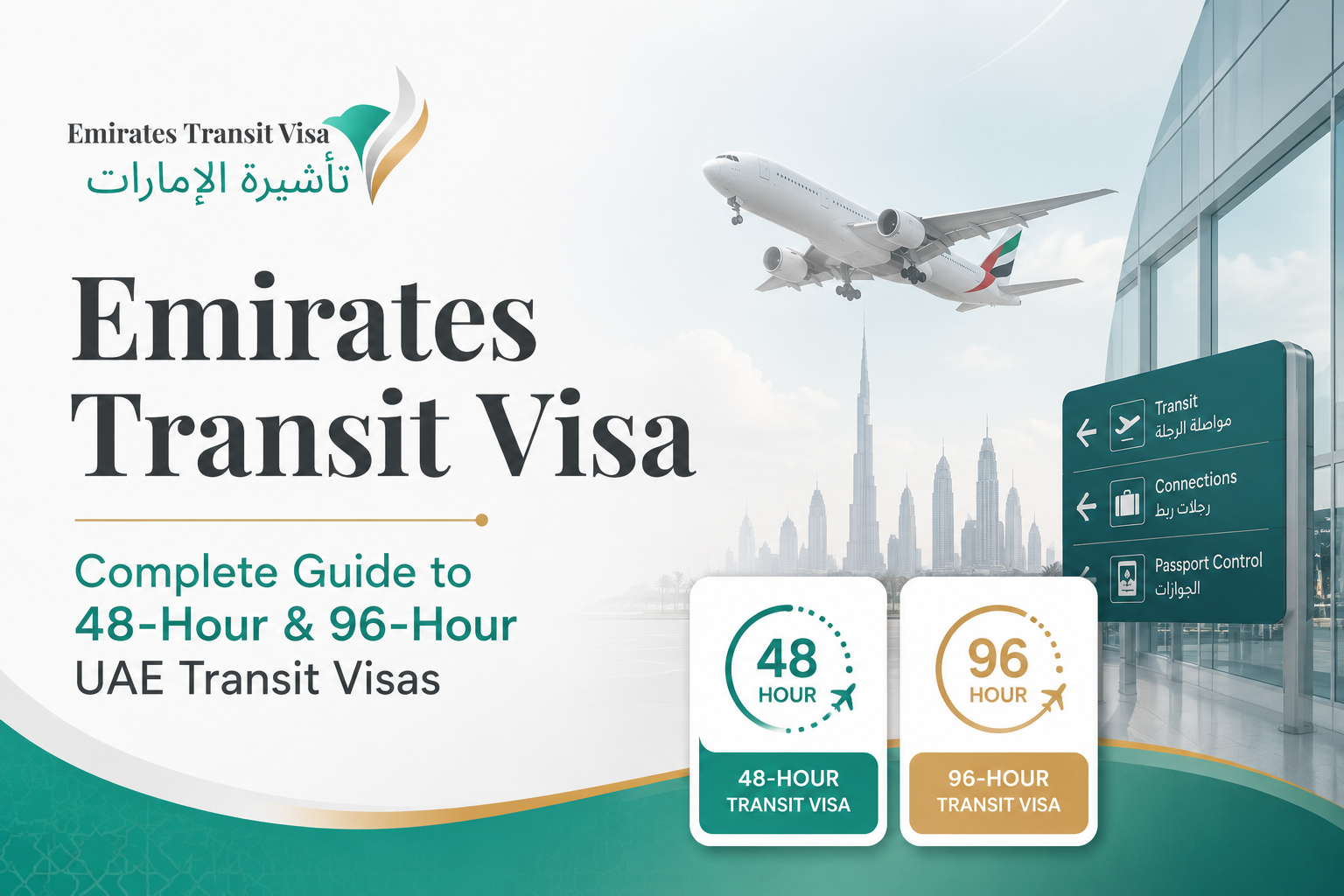
- 48-hour vs. 96-hour transit visa
- Requirements and documents
- How and where to apply
- Emirates transit visa cost, fee & price
- Processing time and tracking
- Emirates Dubai Connect
- Validity, entry and flight-delay rules
- Common mistakes and rejection risks
Emirates Transit Visa — Quick Answer
A transit visa generally only matters if you plan to clear UAE immigration and step outside Dubai International Airport during your Emirates connection. If you're staying entirely within the international transit area, or your passport already qualifies for UAE visa-free entry or visa on arrival, you likely don't need to arrange one in advance. Where a visa is required, it's sponsored by Emirates and arranged before you fly — you choose between the 48-hour and 96-hour duration based on your confirmed onward ticket and how long you actually plan to be outside the airport. Final eligibility, fees, and entry approval remain subject to current UAE immigration rules.
Do You Need an Emirates Transit Visa?
Settle this before anything else — many travellers apply for (and pay for) a visa they didn't actually need.
You may need a transit visa if:
- Your passport isn't eligible for UAE visa-free entry or visa on arrival
- You intend to clear immigration and leave the airport, even briefly
- Your itinerary requires you to collect and recheck your own baggage
- Your connection involves a hotel stay outside the airport's transit zone
You likely don't need one if:
- You remain inside the international transit area for your entire connection
- Your baggage is checked through to your final destination and you're not leaving the terminal
- Your nationality already qualifies for UAE visa-free entry or visa on arrival — in which case you can use that instead, even if you do plan to leave the airport
Airline routing and your specific itinerary both affect whether you personally need a visa — confirm your exact case with Emirates or your sponsor before applying.
Airside Transit vs. Leaving the Airport
The most common point of confusion: "staying at the airport" and "not needing a visa" usually overlap, but not always.
| Situation | Immigration Clearance | Transit Visa May Be Needed? | What to Confirm |
|---|---|---|---|
| Remain airside | Usually no UAE entry | Depends on nationality | Boarding pass and baggage-through arrangement |
| Leave the airport | Yes | Often, unless visa-free or visa on arrival | Entry eligibility for your passport |
| Collect and recheck baggage | May require entry | Possible | Emirates' handling process for your ticket type |
| Stay at an airport hotel | Depends on hotel location | Possible | Whether the hotel sits airside or landside |
If your bags are checked through to your final destination on a single Emirates ticket, you'll generally move airside without needing to clear immigration. Separate-ticket itineraries often require collecting and rechecking bags yourself, which can mean clearing immigration even on a short connection. If you plan to leave the airport, build in time to clear immigration both ways and reach your gate with a comfortable margin — a long layover on paper isn't automatically enough once immigration and transfer time are factored in.
What Is an Emirates Transit Visa?
An Emirates transit visa is a short-stay UAE entry permit for passengers connecting through Dubai on an Emirates or Emirates-codeshare ticket who need to formally enter the country rather than remain airside. Unlike a standard tourist visa, it's tied specifically to a confirmed onward journey to a third country, issued for a short fixed stay, and sponsored directly by Emirates rather than a hotel or individual sponsor.
Emirates issues transit visas in two durations — 48 hours and 96 hours — and once issued, one cannot be upgraded or converted into the other. If your plans call for a longer or more open-ended UAE visit, a standard tourist visa is the correct product, not a stretched transit visa.
"Layover visa" and "stopover visa" are traveller shorthand rather than official visa categories — the actual permit you need is whichever transit visa duration (or, where genuinely applicable, visa-on-arrival) matches your confirmed itinerary and eligibility.
48-Hour vs. 96-Hour Emirates Transit Visa
Both durations are single-entry permits arranged in advance. Neither can be extended, renewed, or converted into the other once issued.
| Feature | 48-Hour Visa | 96-Hour Visa |
|---|---|---|
| Best for | Short layover | Longer stopover |
| Maximum stay | 48 hours from recorded entry | 96 hours from recorded entry |
| Entry type | Single entry | Single entry |
| Extension | Not extendable | Not extendable |
| Onward ticket | Confirmed ticket to a different destination generally required | Confirmed ticket to a different destination generally required |
| Government fee | Free (historically) | Approx. AED 50 |
| Emirates covered | All 7 emirates | All 7 emirates |
Choose the 48-hour visa if your entire stay — including immigration and airport-return time — comfortably fits inside two days and your onward flight is firmly confirmed. Choose the 96-hour visa if your stopover genuinely runs longer, or you want a buffer for rest or schedule changes. Don't pick the shorter option purely to save cost if the timing is genuinely tight — a missed exit window leads to an overstay fine, not a refund.
Emirates Transit Visa Requirements and Documents
Exact requirements vary by nationality, but the broad conditions to expect include:
- An eligible passport with at least 6 months' remaining validity (confirm the exact figure for your specific nationality)
- A confirmed onward ticket to a destination different from where you arrived
- A recent personal photograph against a plain white background
- Complete, accurate itinerary details matching your passport exactly
- No condition currently restricting your entry into the UAE
Documents to have ready:
- Passport bio-data page, scanned clearly with all four corners visible
- A recent colour photograph, plain white background, taken within the last 3 months
- Confirmed inbound and onward flight details, including your Emirates ticket (or EK-codeshare ticket number)
- Current contact details
- Where applicable: a hotel booking confirmation if your layover exceeds 24 hours, or your host's Emirates ID and UAE residence visa copy
Not every requirement applies identically to every applicant — confirm your specific document list before paying any fee.
How and Where to Apply for an Emirates Transit Visa
The transit visa must be applied for and processed through an eligible sponsoring channel before you travel — it isn't something you can obtain after landing. We are an independently licensed UAE travel and visa agency and handle this application on your behalf, from document review through to submission and tracking.
- Check whether a visa is genuinely required for your nationality and itinerary — we can confirm this for you before you pay anything.
- Confirm your full connecting itinerary, including the onward leg to a third country.
- Decide between the 48-hour and 96-hour visa based on how long you actually plan to spend outside the airport.
- Submit your application with us, entering passport and travel details exactly as they appear on your passport.
- Upload the required documents in colour — we review these before submission to catch common rejection triggers (cropped scans, mismatched details) before they cost you processing time.
- Review the full fee breakdown, then pay through a secure payment channel.
- Save your application reference number and track it until a decision is issued.
- Review every field on the issued e-visa carefully before you travel, and contact us immediately if anything looks incorrect.
Once you've confirmed you need a visa and picked a duration, start with the correct service: apply for a 48-hour transit visa or apply for a 96-hour transit visa.
If your travel date is very close, applications for Dubai-issued transit visas are also accepted in person at the Commercial Visa office, Dubai International Airport Terminal 3 — though this removes the document-review support and convenience of applying ahead of time through our platform.
Emirates Transit Visa Cost, Fee & Price
Transit visa cost is made up of a few separate parts — it helps to know which is which before you pay anything.
| Cost Component | What It Covers | Notes |
|---|---|---|
| Government/authority fee | Approx. AED 50 for the 96-hour visa; historically free for the 48-hour visa | Set by UAE immigration authorities; can change without notice |
| Airline sponsorship fee | Processing and sponsorship handled by Emirates | Included in most application packages |
| Service/provider fee | Application assistance, document review and submission handling | Varies by provider — compare total cost, not just the headline government fee |
| UAE airport departure fee | AED 30 per passenger | Usually already bundled into your Emirates ticket |
| Overstay fine | AED 50 per day from day one, no grace period | Under the UAE's current unified fine system, effective February 2026 |
The package price you pay to a visa service is separate from the government fee itself and shouldn't be described as one. Fees are reviewed and updated regularly on this page, but always confirm the current total before paying — government fees and exchange rates both fluctuate.
Processing Time and Application Tracking
Processing time depends on your application channel, and the clock generally starts once your documents are complete and accepted — not from the moment you pay. Typical processing runs 2 to 4 working days for standard applications; apply at least 7 to 10 days before travel to leave a buffer for any document corrections.
- Applications submitted through our platform: track using your application reference number on our visa status page.
- Official verification: UAE government transit visa information is published at u.ae; visas issued specifically for Dubai can be verified through GDRFA Dubai, and permits issued through the other six emirates through the ICP Federal Authority.
Internal tracking reflects the status of a specific application — it isn't the same as universal immigration-database access, and a passport number alone may not always be sufficient to retrieve a result.
Emirates Dubai Connect
Emirates passengers with a long layover in Dubai may separately qualify for Dubai Connect, Emirates' own complimentary stopover programme — distinct from an independently purchased transit visa. Under Emirates' published terms, eligibility generally depends on your connection time falling within a specific window, both flights being on a single Emirates-issued ticket, and certain fare conditions being met. Where a booking qualifies, Emirates may provide hotel accommodation, meals, and transfers, along with a complimentary transit visa for nationalities that need one — arranged directly through the airline.
Dubai Connect has its own eligibility rules, is separate from the paid transit visa process described in this guide, and terms can change without notice. If you think your booking might qualify, check directly with Emirates when you book or manage your reservation. Passengers who don't qualify for Dubai Connect, or whose booking doesn't meet its conditions, generally still need to arrange a transit visa through the standard process above.
Validity, Entry and Flight-Delay Rules
Four separate concepts often get bundled under "validity" — worth untangling clearly:
- Entry validity — the window during which the issued visa can actually be used to enter the UAE (typically 30 days from issue).
- Permitted stay — the maximum time allowed after clearing immigration: 48 or 96 hours depending on which visa was issued.
- Entry type — both transit visa categories are single-entry only.
- Extension — neither category can be extended or renewed, and a 48-hour visa cannot later be converted into a 96-hour one.
Your permitted stay is counted from your recorded entry into the UAE — check your issued visa and entry stamp rather than calculating the deadline from your flight's scheduled arrival time. Build in a genuine buffer for your return to the airport before your permitted stay ends.
If your connecting flight is delayed or changes: don't assume your permitted stay automatically extends to cover it. Contact Emirates immediately and keep written records of the disruption. If you cannot depart within your permitted stay, contact UAE immigration before the visa expires rather than after — remaining in the UAE beyond your permitted stay without confirmed guidance carries real risk.
Common Mistakes and Rejection Risks
Application mistakes to avoid:
- Assuming airside transit and UAE entry are the same thing
- Applying for a transit visa despite already qualifying for visa-on-arrival, without checking first
- Choosing a shorter visa duration than the itinerary actually needs
- Booking a return ticket instead of a genuinely qualifying onward route to a third country
- Ignoring baggage-collection requirements on separate-ticket itineraries
- Mismatched passport details between the application and the passport itself
- Uploading blurry, cropped, or black-and-white documents
- Applying too close to the travel date, leaving no room for corrections
Possible contributing factors behind a delay or rejection include incorrect information, unclear documents, a passport-validity issue, a missing onward ticket, or additional nationality-specific requirements. None of these guarantees rejection on its own.
Whatever channel you apply through: carry your issued visa and passport at all times, and check that the issued visa correctly shows your name, passport number, entry type, and permitted stay before you travel. Immigration officers make the final decision on entry at the border regardless of visa status — an approved visa is a necessary condition for travel, not a guarantee of admission.